How AI Hunts Zero-Day Exploits Faster Than Humans: Threats and Countermeasures
Discover how AI accelerates zero-day exploit discovery, what real-world attacks reveal, and the layered defenses organizations need to stay ahead of automated threats.

Zero-day exploits remain one of the most dangerous cybersecurity threats because attackers can abuse vulnerabilities before developers or organizations know those weaknesses exist. With the rise of AI-driven automation, vulnerability discovery is becoming faster, more scalable, and increasingly difficult to contain. This article examines how AI is accelerating zero-day exploit hunting, how attackers use automated systems to identify weaknesses, and the countermeasures organizations rely on to detect, monitor, and reduce exploitation risks.
Introduction
A security researcher notices unusual traffic targeting a widely used enterprise application late at night. At first, the activity appears harmless. Within hours, attackers begin exploiting a previously unknown vulnerability before developers even realize it exists.
By the next morning, systems across multiple organizations are compromised through the same zero-day exploit. Security teams rush to contain the damage, but the attackers are already adapting their methods, automating scans, and identifying additional weaknesses faster than human analysts can respond.
This is the growing reality of modern cybersecurity. With advances in AI threat detection, automated penetration testing, and machine learning-based security systems, both attackers and defenders are operating at unprecedented speed. AI-driven tools can now analyze massive attack surfaces, discover hidden vulnerabilities, and accelerate zero-day exploit hunting in ways that were previously impossible.
As automated vulnerability discovery becomes more advanced, organizations face a new challenge: defending against threats that can evolve and spread before traditional security processes have time to react.
What Is a Zero-Day Exploit?
A zero-day exploit is a cyberattack that targets a software vulnerability before the vendor has released a patch or is even aware the flaw exists. The term “zero-day” reflects the fact that developers have had zero days to respond. The attacker strikes while the door is still open.
These exploits can enable unauthorized access, remote code execution, data theft, or silent lateral movement across networks. What makes them uniquely dangerous is that traditional security tools, which are built around known signatures and previously reported vulnerabilities, have no reference point for an attack pattern they have never seen before. By the time analysts recognize what is happening, the damage is often already done.
Why Zero-Day Exploits Are So Dangerous
Most cybersecurity defenses rely on known attack patterns: signatures, indicators of compromise, and vulnerability databases. Zero-day exploits sidestep all of this. There is no patch to apply, no detection rule to trigger, and no historical baseline to compare against.
This creates a critical exposure window where attackers can operate without raising alarms. When automated systems scale these attacks across multiple targets simultaneously, a single unknown flaw in widely deployed software can compromise governments, enterprises, healthcare systems, and financial networks within hours.
Unlike conventional attacks, zero-day exploits often succeed before security teams can analyze the threat, let alone respond to it.
How AI Is Changing Vulnerability Discovery

Traditional vulnerability research depended on manual code reviews, human-driven penetration testing, and incremental fuzzing. Skilled and thorough as these methods are, they do not scale, and attackers know it.
Modern machine learning systems can analyze enormous volumes of source code, network behavior, and application logic far faster than any human team. Instead of testing one scenario at a time, automated systems continuously scan for unusual patterns, insecure configurations, and exploitable weaknesses across entire attack surfaces.
This has transformed both AI red teaming, where intelligent systems simulate adversarial attacks to find vulnerabilities before real attackers do, and offensive operations, where threat actors increasingly use the same tooling to locate zero-days and accelerate exploit development.
As AI-driven analysis improves, the gap between vulnerability discovery and exploitation keeps shrinking. Organizations face growing pressure to find and patch weaknesses before automated systems beat them to it.
Automated Zero-Day Exploit Hunting: How It Works
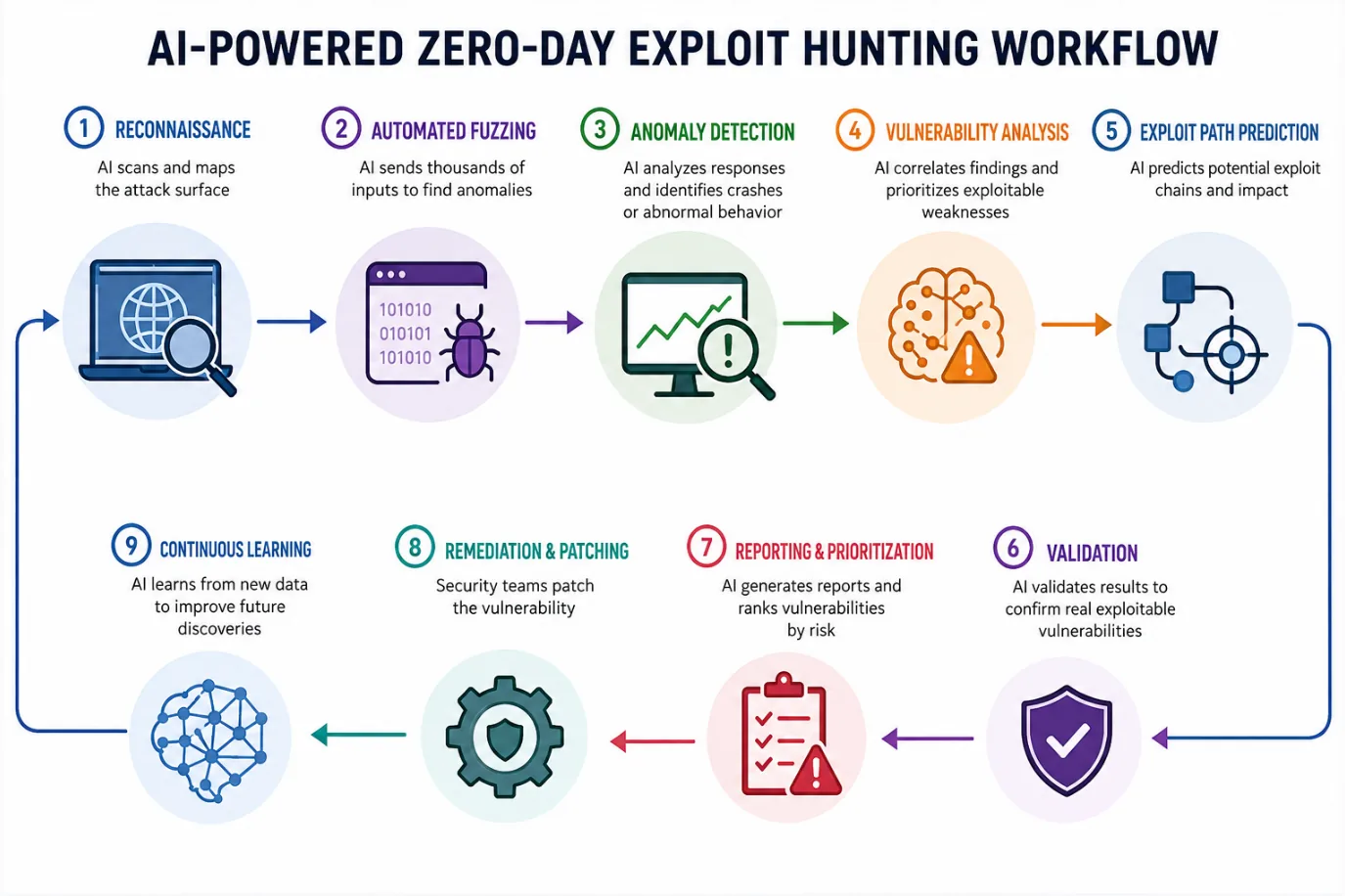
Automated zero-day exploit hunting uses AI-driven systems to identify hidden vulnerabilities with minimal human involvement. These systems analyze software behavior, application logic, memory activity, and network interactions at machine speed.
One of the most common approaches is AI-assisted fuzzing, where automated tools continuously feed unexpected or malformed inputs into applications to trigger crashes, memory corruption, or abnormal behavior. Machine learning models then analyze these results to surface patterns that suggest exploitable weaknesses.
More advanced systems combine automated code analysis, attack surface mapping, and behavioral modeling to prioritize vulnerabilities most likely to lead to successful exploitation. In some pipelines, AI can even suggest likely exploit paths by modeling how different weaknesses interact within a system.
The result is that attackers can scale exploit discovery faster than ever, while security researchers and enterprise teams increasingly depend on AI-powered testing frameworks to identify vulnerabilities before they are weaponized.
Real-World Zero-Day Exploit Attacks
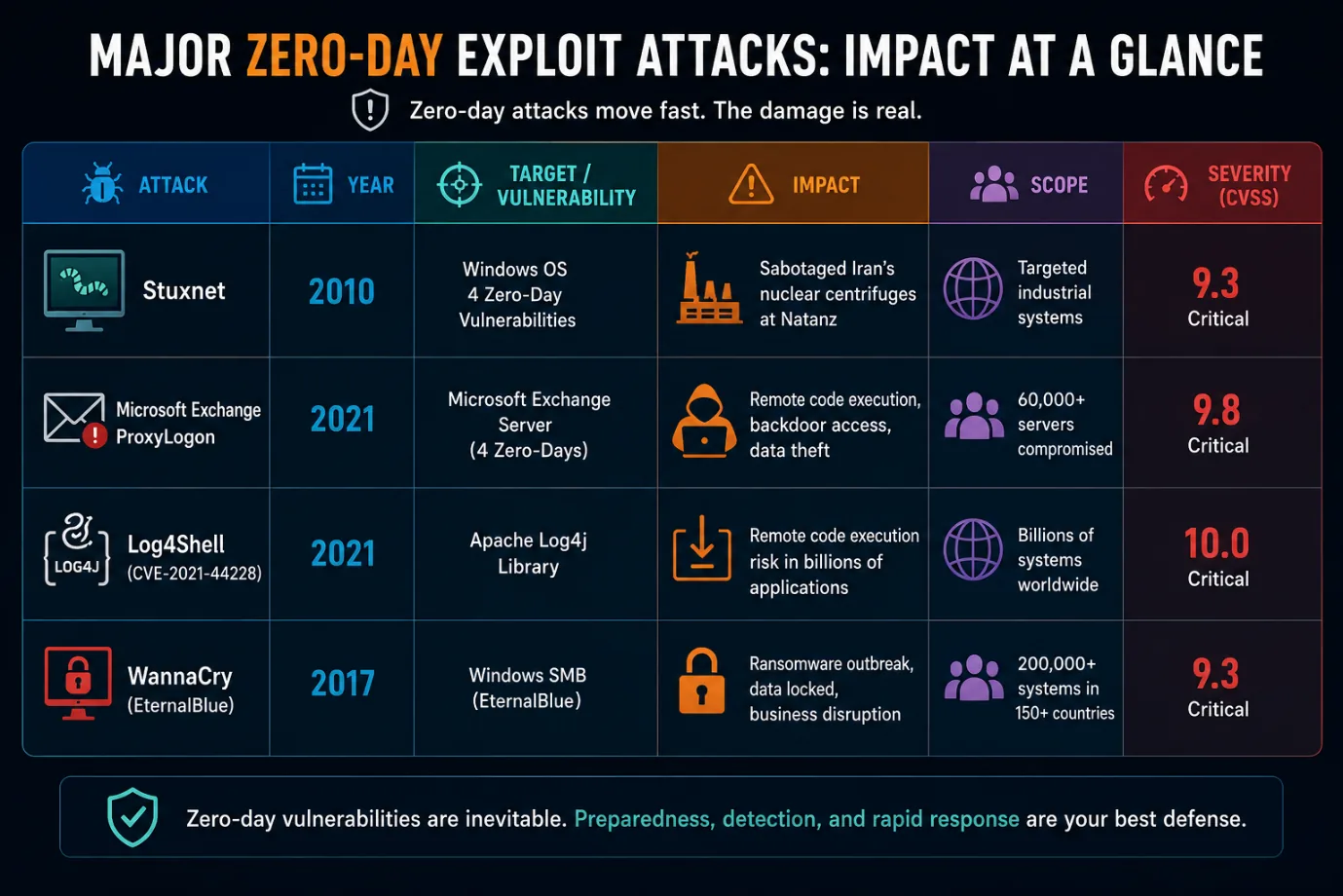
History makes the stakes concrete. Zero-day exploits have enabled some of the most damaging cyberattacks ever recorded, and in every case, the speed of exploitation outpaced the speed of defense.
Stuxnet (discovered 2010) is one of the most studied examples. The worm used four zero-day vulnerabilities against Windows systems, an unprecedented number at the time, to sabotage Iran’s uranium enrichment centrifuges at Natanz. Its sophistication demonstrated that zero-day exploit chains could bypass hardened industrial environments and cause real-world physical damage.
Microsoft Exchange ProxyLogon (2021) showed how rapidly opportunistic attackers capitalize on disclosed vulnerabilities. Four zero-day flaws in Microsoft Exchange servers allowed attackers, initially the Chinese state-sponsored group Hafnium, to bypass authentication and install backdoor web shells. Microsoft released emergency patches on March 2, 2021, but exploitation accelerated as other groups raced to hit unpatched servers: an estimated 250,000 servers were affected globally, with reports of 60,000 organizations compromised in the following days.
Log4Shell (CVE-2021-44228, disclosed December 2021) was arguably the most alarming in terms of scale. The vulnerability lived inside Apache Log4j, an open-source Java logging library embedded in millions of applications, from enterprise software to cloud platforms used by Amazon, Microsoft, and Google. Attackers began scanning and exploiting exposed systems within hours of public disclosure. CISA Director Jen Easterly described it as “one of the most serious I’ve seen in my entire career, if not the most serious.” Apache assigned it the maximum possible CVSS score of 10.0.
WannaCry (2017) demonstrated what happens when nation-state exploit tooling escapes controlled use. The ransomware leveraged EternalBlue, an NSA exploit for a Windows SMB flaw that had been held as a zero-day until it leaked. Microsoft had patched the flaw (MS17-010) two months before the outbreak, yet WannaCry still spread across more than 150 countries in a matter of days, crippling the UK’s National Health Service, logistics firms, and telecommunications companies. It is a reminder that the exposure window does not close when a patch ships, only when it is applied.
These incidents share a common thread: once attackers have a working exploit for a vulnerability defenders have not addressed, organizations have very little time to detect, contain, and recover.
AI-Powered Exploit Detection and Monitoring
As zero-day exploits become more sophisticated, organizations are shifting from signature-based detection to behavioral monitoring powered by AI. The goal is to identify suspicious patterns before attacks escalate, even when the exact vulnerability is still unknown.
Modern AI threat detection systems flag anomalies such as unexpected privilege escalation, abnormal process execution, unusual outbound traffic, or exploit-like access patterns in real time. Rather than waiting for a known attack signature to match, they build behavioral baselines and alert on meaningful deviations.
Security operations centers increasingly use endpoint telemetry, threat intelligence feeds, and automated correlation engines to continuously monitor large environments. Instead of manually investigating isolated alerts, AI-driven systems connect related events across multiple systems and surface the most critical threats for analyst review.
This approach matters because automated exploit hunting allows attackers to move faster than traditional response workflows. Organizations relying only on static defenses often find out about an intrusion long after the damage is done.
Monitoring Exploit Attempts with Python
Because zero-day exploits bypass traditional signatures, security teams often monitor for behavioral indicators that suggest exploitation is underway. The example below shows a basic detection function that flags combinations of suspicious activity patterns, a simplified version of the logic used in production behavioral monitoring systems.
suspicious_events = [
    "unexpected_privilege_escalation",
    "multiple_failed_logins",
    "remote_code_execution_attempt",
    "unusual_network_request"
]

def detect_exploit_attempt(event_log):
    score = 0
    for event in suspicious_events:
        if event in event_log:
            score += 1
    return "Potential Exploit Activity Detected" if score >= 2 else "No Immediate Threat"

sample_log = [
    "remote_code_execution_attempt",
    "unusual_network_request"
]

print(detect_exploit_attempt(sample_log))
Output:
Potential Exploit Activity Detected
This score-based approach works because attackers often change their payloads or delivery mechanisms while repeating the same operational behaviors. Enterprise systems expand on this logic using machine learning models, endpoint telemetry, and automated correlation to detect large-scale attacks across distributed environments.
Vulnerability Management Frameworks
Effective vulnerability management is no longer a quarterly exercise. As automated exploit discovery accelerates, organizations need continuous visibility into their attack surfaces and structured workflows for prioritizing what to fix first.
Most enterprise security teams anchor their programs to established frameworks:
- NIST Cybersecurity Framework (CSF): Provides a risk-based structure for identifying, protecting, detecting, responding, and recovering across an organization’s security posture.
- MITRE ATT&CK: Maps adversary tactics, techniques, and procedures so defenders can model how exploits progress through a network and identify where controls are missing.
- Common Vulnerability Scoring System (CVSS): Provides standardized severity scores that help teams prioritize remediation based on exploitability and potential impact.
Modern vulnerability management platforms layer AI-powered threat intelligence, attack surface monitoring, and automated risk analysis on top of these frameworks. Rather than treating every vulnerability as equally urgent, organizations can prioritize weaknesses that are actively being exploited in the wild or linked to known threat campaigns.
This capability becomes essential when a zero-day surfaces: continuous visibility reduces the window of opportunity available to attackers before a patch is available and applied.
Practical Defense Measures Against Zero-Day Attacks
Defending against zero-day exploits requires a layered strategy that combines prevention, detection, and rapid response. No single control is sufficient against an unknown vulnerability.
Reduce the attack surface. Limit exposed services, remove unnecessary software, apply least-privilege access controls, and keep systems patched for known vulnerabilities. Even when a zero-day has no fix, a smaller attack surface limits what attackers can reach.
Deploy behavioral monitoring. Endpoint detection and response (EDR) platforms, network anomaly detection, and AI-powered threat detection systems can identify exploitation patterns even when no signature exists.
Integrate threat intelligence. Automated feeds and alert correlation help security teams stay current on emerging exploit campaigns and identify whether newly disclosed vulnerabilities affect their environment. The CISA Known Exploited Vulnerabilities Catalog tracks actively exploited vulnerabilities in real time and is a practical starting point for any vulnerability management program.
Segment your network. Containment depends on segmentation. If a zero-day establishes an initial foothold, network segmentation limits how far an attacker can move before being stopped.
Train employees. Many zero-day attack chains begin with phishing, credential theft, or social engineering, long before any exploit is deployed. Human awareness remains a critical control layer.
Prepare for the worst. Maintain offline, tested backups and documented incident response procedures. In modern cybersecurity environments, rapid containment and recovery are just as important as prevention.
Key Takeaways
- Zero-day exploits target vulnerabilities before vendors release patches or become aware of the issue, leaving signature-based defenses with nothing to match.
- AI is accelerating automated vulnerability discovery and exploit hunting at a pace no human team can match alone.
- Automated penetration testing and AI red teaming allow both attackers and defenders to identify weaknesses faster. The advantage belongs to whichever side identifies the vulnerability first.
- Real-world incidents including Stuxnet (4 zero-days, 2010), ProxyLogon (250,000 servers, 2021), Log4Shell (CVSS 10.0, 2021), and WannaCry (150+ countries, 2017) show how quickly vulnerabilities can be weaponized at global scale, both before a patch exists and after one ships but is not yet applied.
- Behavior-based monitoring, continuous vulnerability management, and threat intelligence integration are essential layers against threats that have no signature to detect.
- Organizations that combine proactive attack surface reduction with layered defenses and tested incident response plans are best positioned to contain zero-day threats before they spread.
What’s Next: AI-Enhanced Ransomware
Zero-day exploits are one piece of a broader, accelerating threat landscape. Attackers are now combining automated exploit discovery with AI-enhanced ransomware that adapts its behavior, selects targets intelligently, and evades detection during encryption. Modern ransomware campaigns use automation to identify high-value systems, disable security controls, and spread laterally more efficiently than any human operator could manage.
The next article in this series examines how AI-enhanced ransomware works, how attackers automate extortion campaigns at scale, and the defense strategies organizations are using to detect and contain this evolving threat.
Frequently Asked Questions
1. What is a zero-day exploit and how does it work?
A zero-day exploit targets a software vulnerability before the vendor releases a patch or is aware the flaw exists. Attackers use the vulnerability to gain unauthorized access, execute malicious code, or compromise systems while defenders have no available protection.
2. Why are zero-day exploits so dangerous?
There is no patch to apply, no signature to detect, and no established playbook to follow when a zero-day is first used in the wild. Attacks can spread across global networks before security teams even understand what is happening.
3. How is AI changing vulnerability discovery?
AI systems can analyze code, network behavior, and application logic at machine speed, continuously and at scale. This dramatically compresses the time between when a vulnerability exists and when it is discovered, by both defenders and attackers.
4. What is automated zero-day exploit hunting?
It is the use of AI-driven systems, including automated fuzzing, behavioral analysis, and attack surface mapping, to identify hidden vulnerabilities with minimal human involvement. These tools can test thousands of attack vectors simultaneously.
5. How does AI threat detection identify zero-day attacks?
Rather than matching known signatures, AI detection systems build behavioral baselines and flag anomalies: unexpected privilege escalation, suspicious network traffic, abnormal process execution, and other indicators of exploitation that hold true even for previously unseen attack techniques.
6. What were the most significant zero-day exploit attacks?
Stuxnet (2010) used four zero-days to damage Iran’s nuclear centrifuges. Microsoft Exchange ProxyLogon (2021) compromised an estimated 250,000 servers. Log4Shell (2021) received a maximum CVSS score of 10.0 and affected hundreds of millions of devices. WannaCry (2017) used the leaked EternalBlue exploit, originally an NSA-held zero-day, to spread ransomware across 150+ countries.
7. How can organizations reduce zero-day exploitation risk?
Combine strong patch management, continuous attack surface monitoring, behavioral threat detection, network segmentation, employee awareness training, and tested incident response plans. No single control is sufficient on its own.