AI-Driven Ransomware Attacks: Real-World Cases and Defense Strategies
Learn how AI-driven ransomware attacks use automation to accelerate propagation. Explore real-world cases, detection methods, and defense strategies.
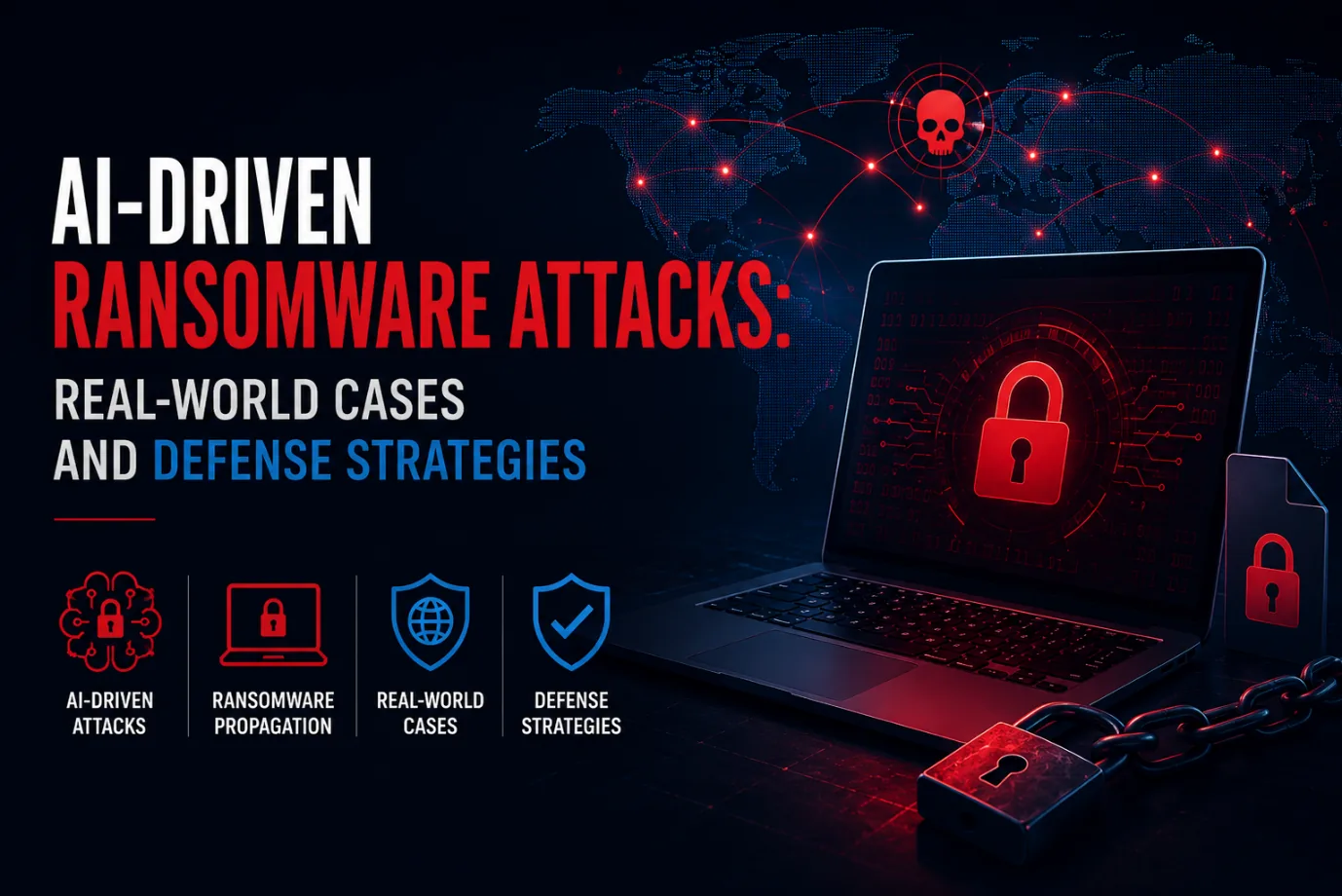
AI-driven ransomware attacks use automation, machine learning, and data analysis to identify targets, spread across networks, and increase the impact of an attack. These campaigns can accelerate ransomware propagation and reduce the time available for detection and response.
This guide examines major ransomware attacks, supply chain risks, detection techniques, and defense strategies used to reduce ransomware risk.
Introduction
A routine security alert appears on a company’s dashboard late on a Friday evening. Within hours, hundreds of systems become inaccessible as files are encrypted across multiple departments. Employees are locked out of critical applications, operations grind to a halt, and attackers demand payment in exchange for a decryption key.
Incidents like these are no longer isolated events. Ransomware attacks have evolved into highly organized operations capable of disrupting businesses, government agencies, healthcare providers, and critical infrastructure. Security researchers are now observing the growing use of automation and AI-assisted techniques that help attackers identify targets, move through networks, and scale attacks more efficiently.
As ransomware groups adopt more advanced tools, organizations face increasing pressure to detect suspicious activity early, limit lateral movement, and contain threats before widespread encryption occurs.
What are AI-Driven Ransomware Attacks?
In practice, that means applying automation and machine learning at each stage of an attack: choosing targets, spreading through networks, and timing encryption for maximum impact.
Security researchers have observed ransomware groups using automated reconnaissance to identify exposed systems, high-value assets, and potential entry points. Some campaigns also use automated credential harvesting, network mapping, and prioritization techniques to move through environments more efficiently after gaining access.
While ransomware still relies on encryption and extortion, the addition of AI-assisted tools can increase the speed, scale, and precision of an attack. As a result, organizations may have less time to detect malicious activity and respond before critical systems are affected.
Why AI Is Changing Modern Ransomware
Ransomware attacks have traditionally depended on manual planning, target selection, and network exploration. Attackers often spent days or weeks identifying valuable systems, gathering credentials, and determining how to maximize disruption before launching encryption.
Automation is changing that process. Modern ransomware operations can scan large environments, identify vulnerable devices, prioritize high-value assets, and collect intelligence far faster than human operators working alone. Tasks that once required extensive reconnaissance can now be performed at scale across thousands of systems.
Faster network discovery, automated decision-making, and rapid propagation can reduce the time between initial access and ransomware deployment. For security teams, that means shorter response windows and greater pressure to detect suspicious activity before an attack spreads across critical systems.
AI-Driven Ransomware Propagation and Lateral Movement
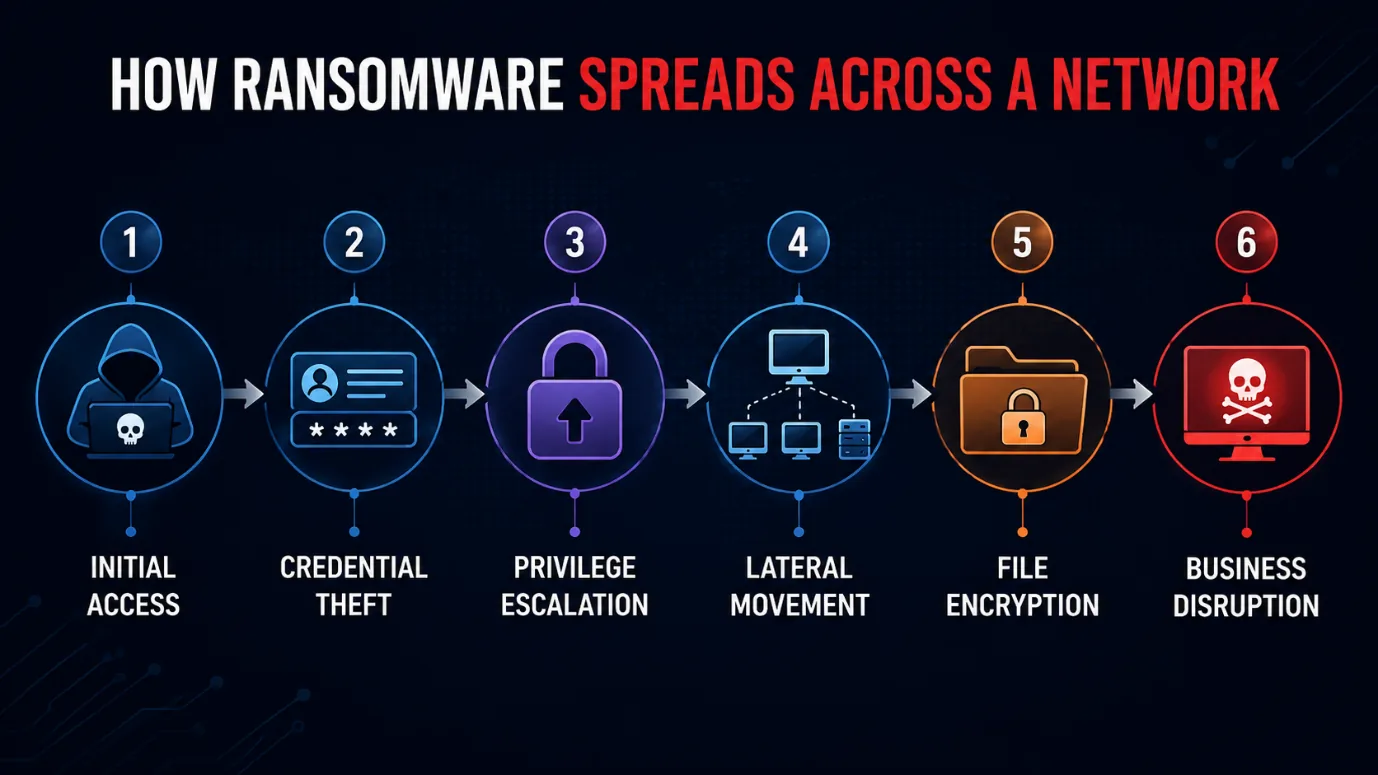
Once ransomware gains initial access to a system, the next objective is spreading across the environment before security teams can respond. This process, known as lateral movement, allows attackers to move from one device to another, access sensitive systems, and maximize the impact of encryption.
Modern ransomware groups increasingly rely on automation to accelerate this process. Instead of manually exploring networks, automated tools can identify connected devices, discover shared resources, map user privileges, and locate high-value assets within minutes. This allows attackers to expand their reach quickly and target systems that are most critical to business operations.
Common propagation techniques include:
- Credential theft and account compromise
- Privilege escalation to gain administrative access
- Exploitation of unpatched systems and services
- Network share discovery and remote execution
- Abuse of legitimate remote administration tools such as RDP and PsExec
As ransomware spreads, attackers often focus on domain controllers, backup systems, file servers, and critical business applications. Compromising these assets can increase operational disruption and place greater pressure on organizations to pay a ransom.
The combination of automation, rapid propagation, and coordinated lateral movement makes modern ransomware attacks significantly more difficult to contain once an intrusion has begun.
Real-World Ransomware Attacks
Several ransomware attacks have demonstrated how quickly a single compromise can escalate into a large-scale security incident. These cases highlight the importance of early detection, network segmentation, and incident response planning.
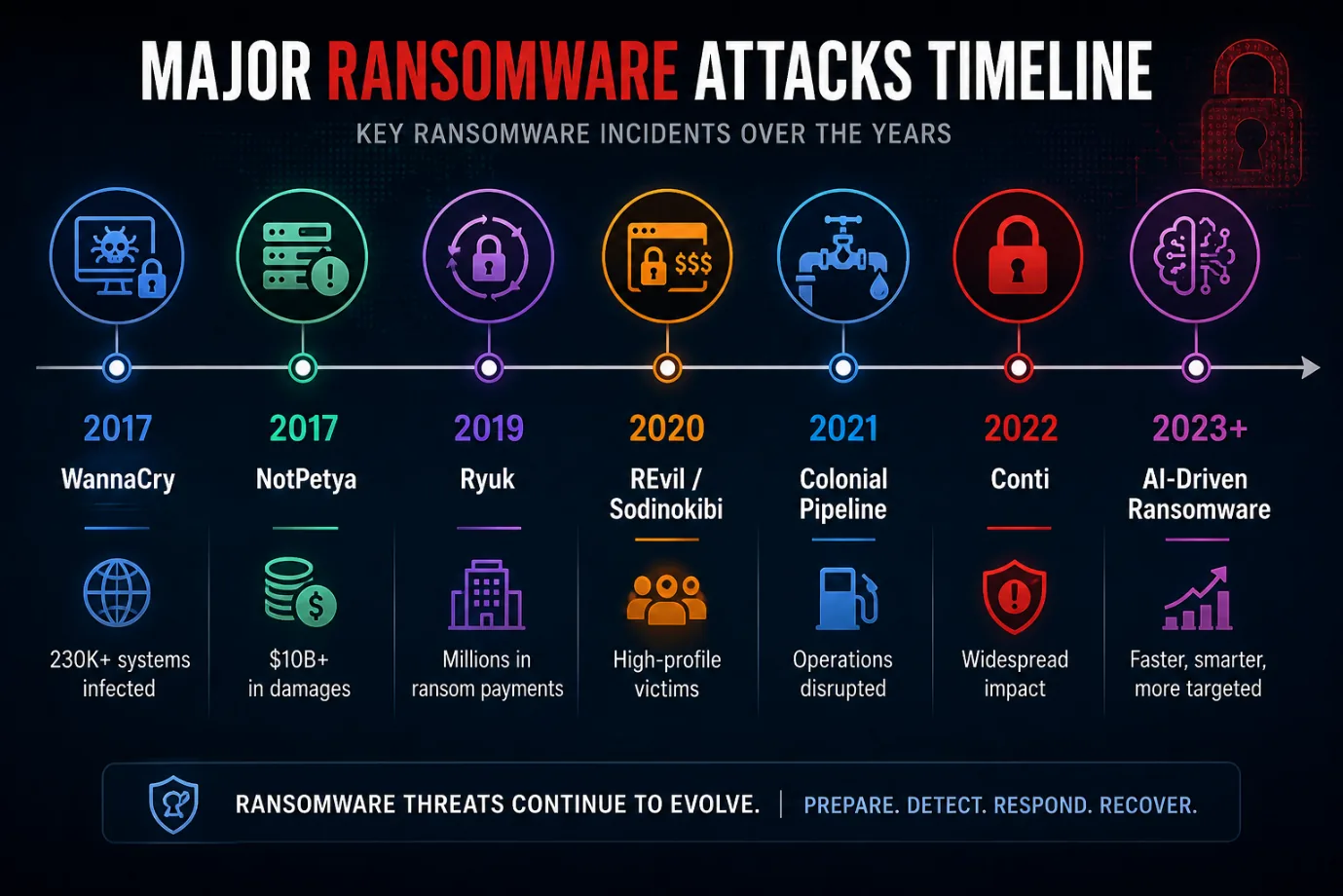
WannaCry (2017)
WannaCry used EternalBlue, a leaked exploit for a Windows SMB vulnerability, and spread automatically across networks without requiring user interaction. Within days, WannaCry infected more than 230,000 computers across over 150 countries, disrupting hospitals, businesses, and government organizations worldwide. The incident demonstrated how unpatched systems can enable rapid ransomware propagation.
Colonial Pipeline (2021)
The DarkSide ransomware attack on Colonial Pipeline disrupted fuel distribution across the US East Coast after attackers gained access through a single compromised VPN password. Although the ransomware primarily affected business systems rather than operational technology, the organization temporarily halted pipeline operations to contain the incident. The attack highlighted the business impact that ransomware can have on critical infrastructure.
REvil and Kaseya (2021)
The REvil ransomware group exploited vulnerabilities in Kaseya’s remote management software to distribute ransomware to managed service providers and their customers. This attack illustrated how threat actors can use trusted software platforms to reach multiple organizations simultaneously, increasing the scale of an incident through supply chain compromise.
LockBit
LockBit was one of the most prolific ransomware operations of recent years until an international law enforcement action, Operation Cronos, disrupted its infrastructure in 2024. The group is known for automating portions of the attack lifecycle, including network discovery, lateral movement, and encryption deployment. LockBit is often cited as an example of how ransomware operations are becoming increasingly automated.
These incidents demonstrate that ransomware attacks are no longer limited to isolated systems.
Supply Chain Attacks and Third-Party Risk
Many organizations invest heavily in securing their own networks, but attackers increasingly look for opportunities within the broader supply chain. Software vendors, service providers, cloud platforms, and managed service providers often have trusted access to multiple customer environments, making them attractive targets for ransomware operators.
A supply chain ransomware attack occurs when attackers compromise a trusted third party and use that access to reach downstream organizations. Rather than targeting hundreds of companies individually, threat actors can exploit a single vendor relationship to expand the scale of an attack.
Common supply chain attack vectors include:
- Compromised software updates
- Vulnerabilities in third-party applications
- Remote management and monitoring tools
- Managed service provider (MSP) environments
- Stolen vendor credentials and privileged accounts
The Kaseya ransomware incident demonstrated how a compromise in a widely used management platform could impact numerous organizations through a single attack path. Similar concerns have emerged from incidents involving SolarWinds and MOVEit, where trusted software became an entry point for large-scale compromise.
As organizations become more interconnected, third-party risk management plays an increasingly important role in ransomware defense. Security teams must evaluate vendor security practices, monitor external access, apply least-privilege principles, and maintain visibility into software and services operating within their environments.
Detecting Ransomware Activity Using Python
Early detection is critical because ransomware can move through a network and encrypt large volumes of data quickly. Security teams often monitor behavioral indicators rather than relying solely on file signatures, since ransomware families frequently modify their code to evade traditional detection methods.
The example below demonstrates a more realistic behavioral scoring function. Rather than checking for a single indicator, it weights multiple signals, because ransomware rarely triggers just one alert in isolation.
# Behavioral indicators with weighted severity scores
INDICATORS = {
    "mass_file_encryption": 40,
    "unexpected_file_modifications": 20,
    "disables_security_tools": 30,
    "unusual_network_activity": 15,
    "privilege_escalation_attempt": 35,
    "backup_deletion_detected": 40,
    "shadow_copy_deletion": 40,
    "lateral_movement_detected": 25,
}

ALERT_THRESHOLD = 60  # Score at which we escalate to critical

def detect_ransomware(event_log: list[str], verbose: bool = False) -> dict:
    """
    Analyzes a list of behavioral events and returns a threat assessment.
    In production, event_log would be fed from EDR telemetry or SIEM alerts.
    """
    score = 0
    matched = []

    for event in event_log:
        if event in INDICATORS:
            weight = INDICATORS[event]
            score += weight
            matched.append((event, weight))

    if verbose:
        print("=== Ransomware Behavioral Analysis ===")
        for event, weight in matched:
            print(f"  [+] {event} (severity: {weight})")
        print(f"  Total Risk Score: {score}")

    return {
        "risk_score": score,
        "matched_indicators": matched,
        "threat_level": (
            "CRITICAL — Isolate host immediately" if score >= ALERT_THRESHOLD
            else "WARNING — Escalate for investigation" if score >= 30
            else "LOW — Continue monitoring"
        ),
    }

# Simulated EDR event feed
sample_log = [
    "mass_file_encryption",
    "shadow_copy_deletion",
    "disables_security_tools",
    "unusual_network_activity",
]

result = detect_ransomware(sample_log, verbose=True)
print(f"\nThreat Level: {result['threat_level']}")
Sample output:
=== Ransomware Behavioral Analysis ===
  [+] mass_file_encryption (severity: 40)
  [+] shadow_copy_deletion (severity: 40)
  [+] disables_security_tools (severity: 30)
  [+] unusual_network_activity (severity: 15)
  Total Risk Score: 125

Threat Level: CRITICAL — Isolate host immediately
This score-based approach works because ransomware often exhibits recognizable behavioral patterns during an attack. Rapid file encryption, abnormal file access activity, attempts to disable security controls, and unexpected network communications can all indicate malicious activity. Enterprise security platforms extend these concepts using endpoint telemetry, machine learning models, threat intelligence feeds, and behavioral analytics to identify ransomware before widespread encryption occurs.
Behavior-Based Ransomware Detection
Traditional antivirus solutions primarily rely on signatures that match known malware samples. While this approach remains valuable, ransomware operators frequently modify their tools, making it difficult to identify every new variant through signatures alone.
Behavior-based detection focuses on what a process does after execution. Instead of examining file characteristics, security systems monitor activity patterns that commonly occur during ransomware attacks. This approach can help identify threats even when the malware itself has not been seen before.
Common behavioral indicators include:
- Rapid encryption of large numbers of files
- Unusual file renaming and extension changes
- Attempts to disable security software
- Unauthorized access to backup repositories
- Lateral movement across endpoints and servers
- Abnormal network communication patterns
Many Endpoint Detection and Response (EDR) platforms use behavioral analytics to identify ransomware activity in real time. By correlating endpoint events, user behavior, network activity, and threat intelligence, these systems can detect suspicious activity earlier and reduce the likelihood of widespread encryption.
Behavior-based monitoring is particularly important as ransomware operations become more automated. Even when attack techniques evolve, the underlying objectives often remain the same: gain access, move through the network, encrypt data, and disrupt business operations. Monitoring those behaviors provides security teams with additional opportunities to detect and contain threats before significant damage occurs.
Defense Strategies Against AI-Driven Ransomware
Defending against ransomware requires a layered security approach that combines prevention, detection, containment, and recovery. As ransomware operations become more automated, organizations need controls that can identify suspicious activity early and limit the impact of an attack.
Key defense strategies include:
- Deploying Endpoint Detection and Response (EDR) solutions to monitor and contain suspicious activity
- Implementing network segmentation to restrict lateral movement between systems
- Enforcing multi-factor authentication (MFA) for privileged and remote access accounts
- Maintaining offline and immutable backups that cannot be encrypted by attackers
- Applying security patches promptly to reduce exposure to known vulnerabilities
- Monitoring user and system behavior for signs of compromise
- Conducting regular security awareness training to reduce phishing-related risks
- Establishing and testing incident response and disaster recovery plans
Organizations should also maintain visibility into third-party software, cloud services, and vendor access paths. Many ransomware attacks begin through compromised credentials, vulnerable applications, or trusted external relationships rather than direct attacks against core infrastructure.
No single security control can prevent every ransomware attack. The most effective defense combines proactive monitoring, rapid detection, strong access controls, and well-tested recovery procedures that allow critical operations to continue even if systems are compromised.
Key Takeaways
- AI and automation let ransomware spread faster, leaving security teams less time to respond.
- Credential theft, privilege escalation, and lateral movement are how attacks scale, and they scale fast.
- WannaCry, Colonial Pipeline, REvil, and LockBit all proved ransomware can cripple entire organizations, not just isolated systems.
- Supply chain compromises multiply damage; one trusted vendor can become a door into hundreds of organizations.
- Behavior-based detection and EDR catch what signatures miss; monitor what processes do, not just what they are.
- MFA, offline backups, network segmentation, and patching are not optional hygiene; they are your containment plan.
- Early detection and tested recovery matter as much as prevention, because no control stops every attack.
What’s Next: Autonomous Penetration Testing
Detecting ransomware once it is running is only half the battle. The other half is finding the weaknesses ransomware relies on, such as exposed services, reused credentials, and flat networks, before attackers do. Autonomous penetration testing uses AI to simulate real attack paths continuously, so gaps are found and fixed between scheduled assessments rather than after an incident.
Read more in our guide to AI-powered penetration testing.
Frequently Asked Questions
1. What are AI-driven ransomware attacks?
AI-driven ransomware attacks use automation, machine learning, and data analysis to improve target identification, network propagation, and attack execution. These techniques can help attackers operate more efficiently and increase the scale of ransomware campaigns.
2. How do ransomware attacks spread across networks?
Ransomware often spreads through credential theft, privilege escalation, exploitation of vulnerable systems, remote execution tools, and lateral movement between connected devices. Automated propagation can accelerate this process significantly.
3. What are examples of major ransomware attacks?
Notable examples include WannaCry, Colonial Pipeline, REvil, and LockBit. These incidents disrupted critical services, affected thousands of organizations, and demonstrated the growing impact of ransomware attacks worldwide.
4. What is a supply chain ransomware attack?
A supply chain ransomware attack occurs when attackers compromise a trusted software vendor, service provider, or third-party platform and use that access to reach multiple organizations. Incidents involving Kaseya and other software providers have highlighted this risk.
5. How can organizations detect ransomware activity?
Organizations commonly use behavior-based monitoring, Endpoint Detection and Response (EDR) platforms, threat intelligence, and anomaly detection systems to identify suspicious activity before widespread encryption occurs.
6. Why is behavior-based ransomware detection important?
Behavior-based detection focuses on suspicious actions such as mass file encryption, privilege escalation, security tool tampering, and abnormal network activity. This approach can identify threats even when malware signatures are unavailable.
7. How can businesses reduce ransomware risk?
Businesses can reduce ransomware risk by implementing multi-factor authentication, maintaining offline backups, applying security patches promptly, segmenting networks, monitoring for suspicious activity, and training employees to recognize phishing attempts and other social engineering attacks.