AI Threat Detection: How Anthropic's Project Glasswing Is Reshaping Cybersecurity in 2026
Anthropic's Project Glasswing used Claude Mythos Preview to find thousands of zero-day vulnerabilities, including a 27-year-old bug. See how AI threat detection is redefining proactive cybersecurity.
Introduction
For years, cybersecurity operated on a simple premise: detect threats, respond quickly, and patch what is broken. That model worked when attacks were slower, patterns were predictable, and vulnerabilities were discovered gradually.
That environment no longer exists.
On April 7, 2026, Anthropic made that reality impossible to ignore. The company launched Project Glasswing, a landmark initiative built around Claude Mythos Preview, an unreleased frontier AI model that had already autonomously discovered thousands of previously unknown software vulnerabilities. Among them was a bug that had gone undetected for 27 years.
This is not a research curiosity. It is a structural shift in how vulnerabilities are found, how fast they can be weaponized, and who holds the advantage. Security can no longer operate in cycles. It must become continuous, proactive, and intelligence-driven.
The real question is no longer about the presence of vulnerabilities. It is who finds them first, and how fast they can act on them.
Project Glasswing Overview
Project Glasswing is Anthropic’s cybersecurity initiative, launched on April 7, 2026, and built around Claude Mythos Preview, its most capable frontier model to date, which remains unreleased. The mission is to find critical vulnerabilities in the world’s most important software before malicious actors can exploit them.
The scale reflects the urgency. Participants in the launch include Amazon Web Services, Apple, Broadcom, Cisco, CrowdStrike, Google, JPMorganChase, the Linux Foundation, Microsoft, NVIDIA, and Palo Alto Networks. More than 40 additional organizations responsible for critical software infrastructure also have access. In total, over 50 organizations are involved. Anthropic has committed up to $100 million in model usage credits and $4 million in direct donations to open-source security organizations.
The early results are hard to overstate. In the weeks before the announcement, Mythos Preview autonomously identified thousands of zero-day vulnerabilities across every major operating system and browser, flaws entirely unknown to their developers. The oldest was a 27-year-old bug in OpenBSD that let an attacker remotely crash any machine running the OS simply by connecting to it. Another was a 17-year-old remote code execution flaw in FreeBSD that allowed an unauthenticated attacker to gain full root access from anywhere on the internet.
Anthropic has chosen not to release Mythos Preview publicly. The reason is direct: the same model that can find these vulnerabilities can also be used to exploit them at scale. The project is, in Anthropic’s own words, “an urgent attempt” to give defenders a head start before similar capabilities reach actors less committed to using them responsibly.
The project is named after the glasswing butterfly, whose transparent wings let it hide in plain sight, much like the long-buried vulnerabilities the project is designed to uncover.
How AI Finds Vulnerabilities
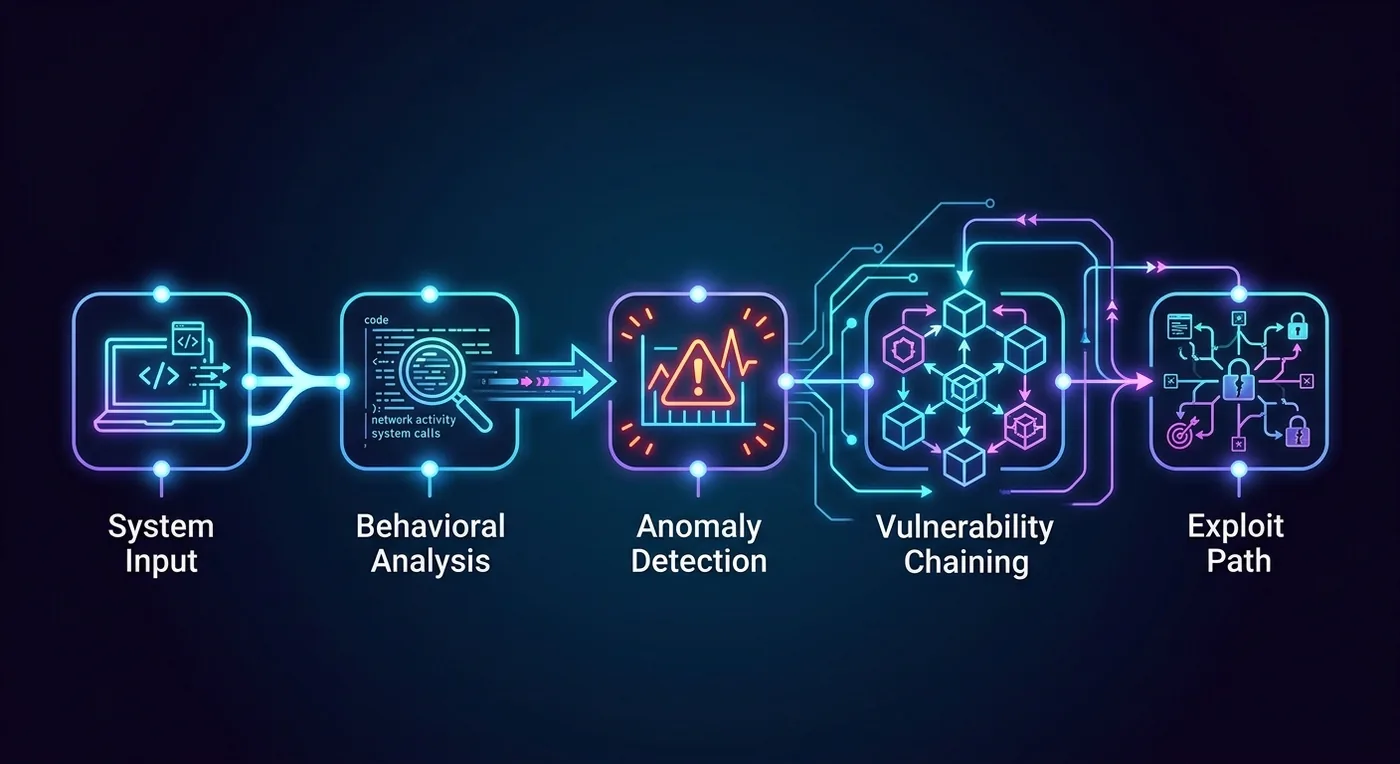
Mythos Preview works much like a skilled security researcher operating at machine speed: it reads code, probes how software behaves, flags anomalies, and then reasons about how individual weaknesses could combine into a working attack. The most consequential capability is vulnerability chaining. Individual flaws are often low severity in isolation. However, when an AI model can reason across multiple weaknesses simultaneously, it can construct attack paths that chain three, four, or five of them into a sophisticated exploit.
In one documented case, Mythos Preview wrote a browser exploit that chained four vulnerabilities, including a complex memory attack, to escape both the browser’s sandbox and the underlying operating system’s protections. Anthropic reports that, once started, the model worked through the exploit without human involvement.
The Rise of Proactive Cybersecurity
The traditional posture of waiting for an alert, investigating, and remediating was designed for a world where exploitation followed discovery by months. Today, that window can be hours. Reactive security is structurally too slow.
Proactive cybersecurity inverts the model. It assumes vulnerabilities exist, because they always do, and builds continuous processes to surface and address them before attackers have a chance to act. Project Glasswing is the clearest current example of this at scale, using advanced AI capability offensively in service of defense.
This shift has implications beyond tooling. Proactive security requires different workflows, different organizational structures, and a different relationship between security teams and the systems they protect. It is less about managing incidents and more about maintaining a living, evolving map of where risk exists.
Continuous Monitoring and Testing
Continuous monitoring and testing sit at the operational core of proactive security. Monitoring provides real-time visibility into system activity, helping detect unusual behavior as it happens. Testing complements this by actively probing systems to uncover weaknesses before they are exploited. Together, they form the foundation of a continuous security model.
Risks of AI in Cybersecurity
The same capabilities that make AI transformative for defense also make it dangerous in the wrong hands. This is the dual-use challenge that sits at the center of Project Glasswing and the reason Anthropic declined to release Mythos Preview publicly. Anthropic has said it is in ongoing discussions with US government officials about the model’s offensive and defensive cyber capabilities.
That is why Project Glasswing limits access to vetted partners, and why Anthropic has committed to sharing what the project learns so the wider industry benefits. Access control, human oversight, and governance are not optional. They are the conditions under which powerful capabilities can be deployed responsibly.
How Organizations Should Adapt
Project Glasswing is a signal about where the threat environment is heading. Organizations that rely on periodic assessments and reactive defense should treat this moment as a catalyst for structural change.
Move from periodic to continuous. This is the most urgent shift. Continuous monitoring and testing do not require access to Mythos Preview. They require recognizing that schedules are no longer a reliable substitute for ongoing visibility.
Take open-source risk seriously. A major focus of Glasswing is open-source software, which underpins most modern systems, including critical infrastructure. Many organizations consume open-source components without meaningful visibility into their security posture. That exposure needs to be inventoried.
Think in compound vulnerabilities, not just individual flaws. Risk scoring that treats weaknesses in isolation misses the threat that AI-powered attackers actually pose. Security processes need to evaluate how multiple findings interact, not just each one on its own.
Pair automation with human judgment. More powerful detection creates more findings. Without strong prioritization, triage, and contextual expertise, increased capability produces more noise, not more clarity. Human oversight remains essential.
Key Takeaways
- Anthropic launched Project Glasswing on April 7, 2026, using Claude Mythos Preview to proactively find and disclose zero-day vulnerabilities before attackers can exploit them.
- Over 50 organizations are involved, including AWS, Apple, Cisco, Google, Microsoft, and the Linux Foundation, backed by $100 million in usage credits.
- Mythos Preview found thousands of zero-day vulnerabilities autonomously, including a 27-year-old OpenBSD bug and a 17-year-old FreeBSD remote code execution flaw.
- The model can chain multiple vulnerabilities into sophisticated exploits, a kind of compound risk that conventional security testing often misses.
- Anthropic has declined to release Mythos Preview publicly due to the severity of its dual-use risk.
- Reactive, signature-based, and periodic security approaches are no longer sufficient against AI-powered adversaries.
- Continuous monitoring, continuous testing, and proactive vulnerability discovery are now operational necessities.
- Governance, access control, and human oversight are essential safeguards, not optional additions.
Future of AI Security
Project Glasswing marks a point on a trajectory, not the destination.
In the near term, capabilities similar to Mythos Preview will proliferate, as Anthropic itself has warned. The question for every organization is whether its defenses will be ahead of that curve or behind it.
In the medium term, security is moving toward continuous autonomous assessment: systems that proactively scan infrastructure, simulate attack paths, and surface prioritized findings without waiting to be invoked. The role of security professionals shifts accordingly, with less manual analysis and more governance, validation, and high-stakes decision-making.
Longer term, the boundary between development and security will continue to blur. AI models that can find vulnerabilities can also help write code with far fewer of them. The prospect of software that is routinely validated against AI-level attack capability before deployment is no longer hypothetical.
What remains constant is the fundamental logic: in a threat environment driven by AI, the advantage goes to whoever finds the vulnerability first. Organizations that understand this and build accordingly are the ones that will come out ahead.
Frequently Asked Questions
1. What is AI threat detection?
AI threat detection analyzes how systems behave over time to identify security risks, rather than relying on known attack signatures. It can detect unusual activity, hidden vulnerabilities, and early indicators of compromise, including threats that have never been seen before, and does so continuously rather than on a schedule.
2. What is Project Glasswing?
Project Glasswing is Anthropic’s cybersecurity initiative, launched on April 7, 2026, using Claude Mythos Preview to find critical software vulnerabilities before attackers can exploit them. It involves over 50 organizations and is backed by $100 million in usage credits from Anthropic.
3. What is Claude Mythos Preview?
Claude Mythos Preview is Anthropic’s most capable, unreleased AI model. It can autonomously discover zero-day vulnerabilities, chain multiple weaknesses into sophisticated exploits, and analyze entire codebases at a scale that far exceeds conventional security tools. Anthropic has not released it publicly due to the severity of the cybersecurity risks it would pose if misused.
4. How is this different from traditional security?
Traditional security relies on known patterns, rule-based detection, and periodic assessments. Project Glasswing demonstrates a different model: continuous, autonomous analysis that finds previously unknown vulnerabilities, including bugs that persisted undetected for 27 years, before any attacker has the chance to discover them.
5. Can these AI systems be misused?
Yes, which is exactly why Anthropic is not releasing Mythos Preview publicly. The same model that finds vulnerabilities defensively can be used to exploit them offensively. Anthropic describes the project as an urgent attempt to give defenders a head start before similar capabilities spread more widely.
6. What should my organization do now?
Audit your open-source software exposure, shift from periodic to continuous security monitoring and testing, and evaluate how your risk processes handle compound vulnerabilities, not just individual findings. The organizations best positioned for what comes next are those building continuous, proactive security practices today.